
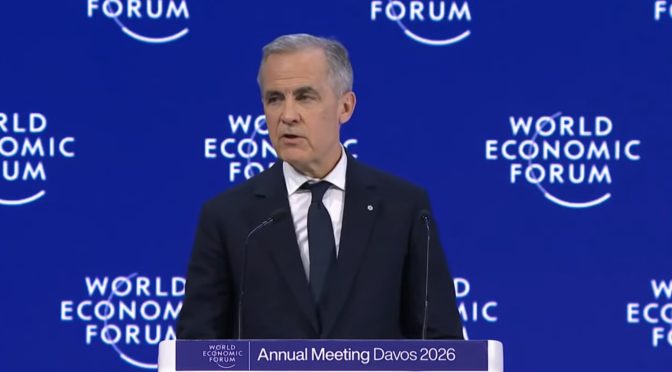
On January 20, Canadian Prime Minister Mark Carney delivered a speech at the World Economic Forum in Davos that has drawn a great deal of praise. The speech was nothing less than a declaration that one era of the world is ending and that a new international order is now taking shape.
The message of the speech
Carney makes two big points. First, we should stop pretending that the current international order still works. Great powers do what they want, and so states must seek out new partners and build new alliances.
The speech opens with a situational diagnosis. The old rules-based international system is breaking down, and nothing appears to constrain the actions of great powers in the world. By “great powers,” Carney is clearly referring to the United States, even though he never names it outright.
In today’s system, great powers exploit interdependence, economically coercing and threatening others. Interdependence once carried a promise of mutual gain, but Carney argues that this promise no longer holds.
On the one hand, this reality must be acknowledged. On the other, we should not resign ourselves to the idea that smaller states are entirely at the mercy of great powers. We should not submit to their arbitrariness in the hope of buying safety.
Because great powers no longer respect the rules, the architecture of collective security is broken. Yet Carney argues it would be a mistake for every country to respond by building its own fortress.
His proposed remedy is to reduce dependence on great powers and to look for new partners. Carney offers examples of how Canada has begun assembling coalitions for different purposes.
The speech ends with an appeal: only together can smaller states stand firm in the face of great powers.
Would a speechwriter have helped?
I understand why so many have been enthusiastic about Carney’s speech. The call to face hard facts feels honest and refreshingly direct, especially in an environment where one so often hears the liturgy of polished platitudes.
The implied confrontation with the United States – even if the “great power” is never named – comes across as upright and bold. Our time also seems to demand voices that can pour hope into the future, and that appear to believe in their own message.
Still, I am not entirely satisfied.
The speech has been praised in part because, according to media reports, Carney wrote it himself, without the help of speechwriters. But might a speechwriter have been useful after all?
If he had had one, the speech would probably not have included language like this:
“We are calibrating our relationships, so their depth reflects our values, and we’re prioritizing broad engagement to maximize our influence, given the fluidity of the world at the moment, the risks that this poses and the stakes for what comes next.”
In this heavy sentence, four things happen at once: what we are doing (“we are calibrating our relationships”), why we are doing it (“so their depth reflects our values”), what we are prioritizing (“prioritizing broad engagement”), and why it all matters (“given the fluidity, the risks, the stakes”).
On top of that, the sentence contains eight abstract terms: calibrating, depth, values, broad engagement, influence, fluidity, risks, stakes.
When an analogy goes off the rails
An even bigger problem, however, is the striking rhetorical muddle at the heart of the speech, crystallized in a single question: how, in Carney’s view, should we relate to the rules-based international order?
Before I can lay out that problem, it is worth briefly revisiting what Carney says about Václav Havel, the Czech dissident during the communist era and later president.
Carney refers to Havel’s 1978 essay The Power of the Powerless and its story of the greengrocer. Each morning, the shopkeeper places a sign in his window that reads: “Workers of the world, unite.” He does not believe the communist slogan himself, but he does not want trouble.
Every other shopkeeper displays the same sign. In this way, Havel illustrates how ordinary people sustain a system built on falsehood by participating in its rituals. He calls this “living within a lie.”
In Havel’s account, the system’s power rests on people’s willingness to take part in the performance. But once even one shopkeeper stops performing and takes the sign down, the illusion begins to crack.
Now back to the rules-based international order. On the one hand, Carney seems to view it positively. Referring to the past, he says that Canada and other countries prospered under it for decades. States benefited from its institutions and its predictability.
Carney then adds that the system was never perfect: the most powerful states could, at times, decide that the rules did not apply to them. He therefore calls the story of the rules-based order a “fiction,” but a useful one: it created stability, constrained arbitrariness, and made values-based foreign policy possible.
Then comes a highly surprising rhetorical move. Still speaking of the past, Carney compares supporting the rules-based order to placing that sign in the window:
“So, we placed the sign in the window. We participated in the rituals, and we largely avoided calling out the gaps between rhetoric and reality.”
The analogy fails badly. The communist system Havel describes was a repressive regime that systematically violated human rights, one in which people participated out of fear and, ultimately, under the threat of violence.
Even in Carney’s own telling, the rules-based international order was not that. He says countries prospered under it. The system was never as perfect as ceremonial speeches might have suggested, but participation in it was not compelled by violence, nor was it undertaken against what people believed to be true. Rather, it was understood as an agreement-based order among states, one that depends on safeguarding agreements and acting as though they are real.
You can call such a system a “fiction” if you like, but in that sense any human-made order of agreements is a fiction: it is not an unavoidable law of nature. It is not a “lie” in Havel’s sense of the word.
Carney’s analogy, then, is not merely imprecise; it commits a category error. It equates a voluntary, agreement-based international order with a coercive system built on fear and violence. Used this way, the analogy suggests that commitment to the rules-based order was, in itself, an unethical performance rather than an attempt to restrain power.
After this, Carney says the current order no longer works. The main reason, in his view, is that great powers have begun weaponizing interdependence. In a world where economic integration has become an instrument for dominating others, talk of mutual benefit becomes “living within a lie” (in reference to Havel).
Carney thus seems to think that the language of mutual benefit has turned into a lie only now, because great powers have destroyed the promise by subordinating others. But this implies that earlier we were not “living within a lie,” at a time when great powers had not yet used integration as a tool of coercion in the way they do today. And yet, he describes sustaining the rules-based order as “placing the sign in the window.” There is a sharp contradiction at the core of the speech.
What Carney may mean
Read charitably, Carney seems to be saying something like this: an agreement-based international order was good and useful, if imperfect. But in recent years great powers have ruined it by exploiting it and subordinating others. For that reason, we should stop maintaining the illusion that it still functions.
This charitable interpretation is reinforced by the fact that, later in the speech, Carney says Canada is now “taking the sign out of the window” by loosening old dependencies and seeking new partners.
Unfortunately, Carney expresses himself in a way that is unhelpfully unclear and thus ends up attacking both the long-standing agreement-based international order and its current, great-power-distorted form.
That is, in my view, a pity. Havel’s analogy is genuinely powerful, and one would not wish to see it used this way, so ambiguously.
So: would a speechwriter have helped? A professional speech partner almost always makes a speech better. At the very least, it reduces the chances of major missteps making their way into the final text.